- Journal Issues
- № 1-2, (2024) Actual problems of criminal justice
- Problems of Criminal Procedure and Criminal Sciences and Operational and Investigative Activities
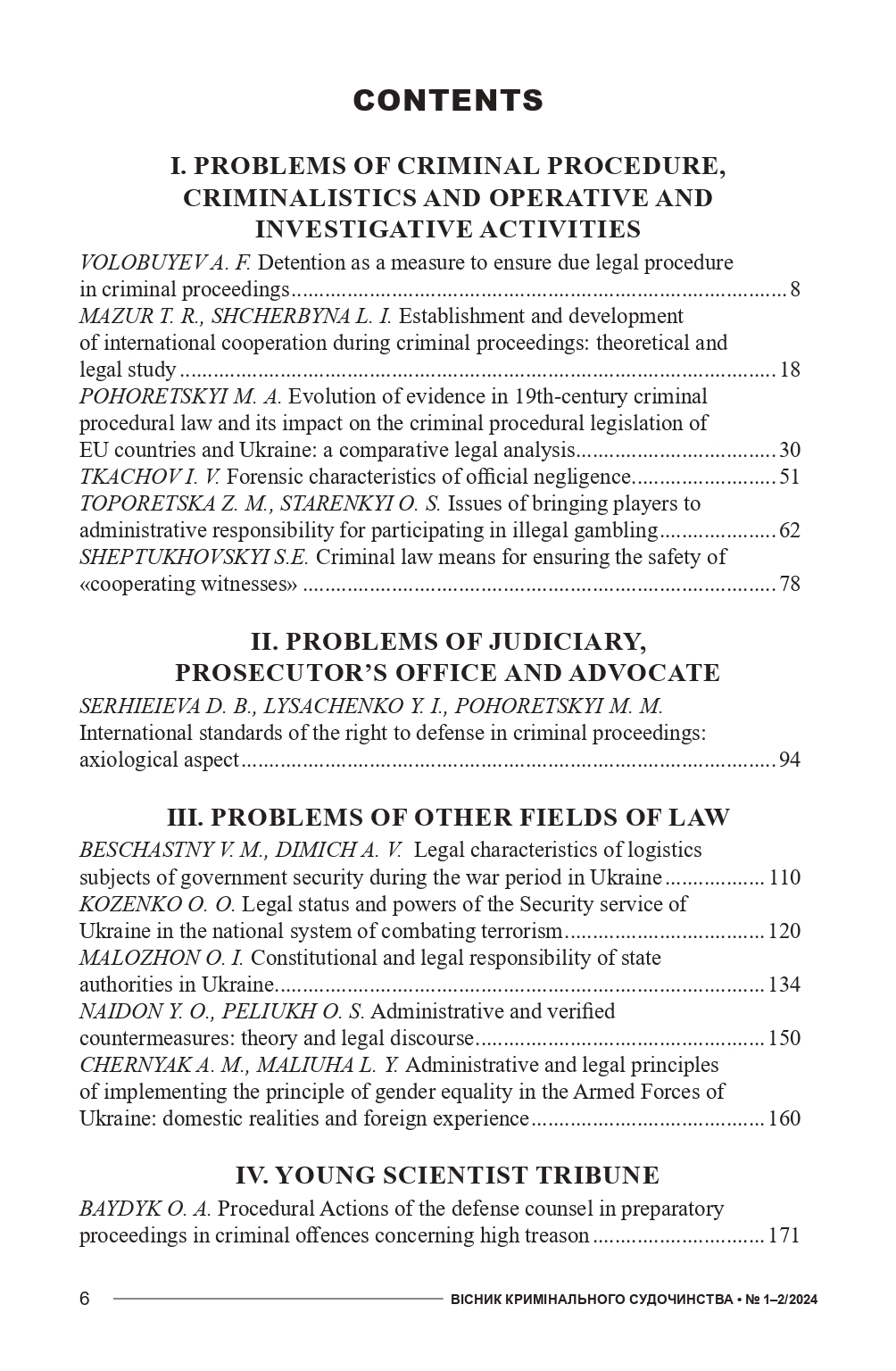
- Evolution of evidence in 19th-century criminal procedural law and its impact on the criminal procedural legislation of EU countries and Ukraine: a comparative legal analysis
Evolution of evidence in 19th-century criminal procedural law and its impact on the criminal procedural legislation of EU countries and Ukraine: a comparative legal analysis
Review
The article provides a comprehensive comparative legal analysis of the evolution of the concept of evidence and the evidentiary process in criminal procedural legislation of the 19th century. It thoroughly examines the key normative acts of that period, particularly the French Code of Criminal Instruction (1808), the Criminal Procedure Statute of the Russian Empire (1864), the Criminal Procedure Code of Austria-Hungary (1873), and the German Criminal Procedure Code (1877). Special attention is given to the historical transition from the medieval formal «arithmetic» of evidence, which was based on predetermined «strength» of each proof, to contemporary standards grounded in the free yet rationally motivated evaluation of evidence by the court and jury.
The author identifies key procedural innovations that laid the foundation for modern continental standards of evidence, such as the principle of internal conviction, strict procedural control over the admissibility of evidence, and clear guarantees for the legality of evidence collection and procedural documentation. The evolution of the role of police and investigative judges in evidence formation is highlighted, including detailed descriptions of the development of procedural purity and formalization of material collection.
Emphasis is placed on the relevance of the historical experience of the 19th century for further improving the criminal procedural legislation of Ukraine, considering contemporary challenges such as European integration, widespread use of digital technologies, and the necessity of effectively counteracting the use of illegal evidence («fruits of the poisonous tree»). The author proposes ways to implement European evidence standards into the Ukrainian legal system, emphasizing the need to enhance procedural form, digitize the evidentiary process, and strengthen the guarantees for protecting the rights of trial participants.
The legacy of the 19th-century codifications establishes four enduring criteria that remain relevant for EU member states and Ukraine in the 21st century. The first criterion is the formalized origin of evidence, where evidence emerges solely through a legally permitted channel, and the police’s role is limited to the operational collection of material without its assessment. The second criterion is the complete chain of custody, from traditional sealing to contemporary cryptographic hashes, ensuring continuity and authenticity. The third criterion involves the public and direct examination of evidence, where orality, publicity, and the possibility of cross-examination are crucial tools to eliminate potential biases. Finally, the fourth criterion is the free yet reasoned evaluation of evidence, requiring judicial internal conviction to be logical and thoroughly justified.
Keywords: criminal procedure, evidence, evidentiary process, internal conviction, procedural form, admissibility of evidence, comparative legal analysis, criminal procedural legislation, European integration, digital evidence, fruits of the poisonous tree.