- Journal Issues
- № 1-2, (2024) Actual problems of criminal justice
- Young Scientist Tribune
- Presentation of a Person for Identification under the 1960 and 2012 Criminal Procedure Codes: comparative Legal Analysis
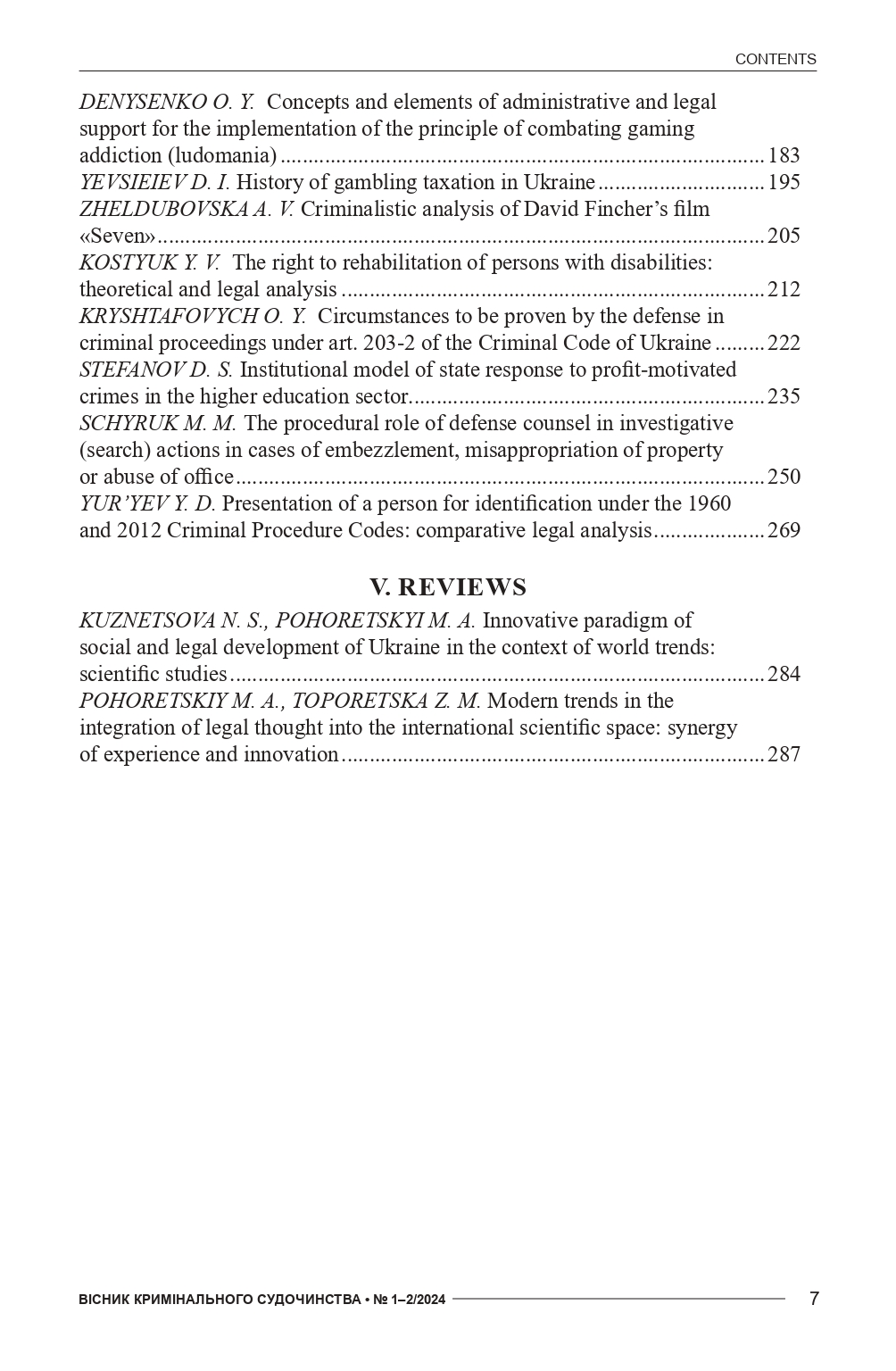
Presentation of a Person for Identification under the 1960 and 2012 Criminal Procedure Codes: comparative Legal Analysis
Review
The article presents an in-depth interdisciplinary analysis of the evolution of legal regulation and practical application of the identification lineup procedure in Ukraine, covering both codifications of criminal-procedure legislation – the 1960 Criminal Procedure Code of the Ukrainian SSR and the current 2012 Criminal Procedure Code of Ukraine. The study is scientifically and practically relevant for three main reasons. First, the state of war and large-scale population displacement have greatly complicated the use of live fillers, sharply increasing reliance on photo line-ups in investigative practice. Second, the lack of procedural status for «other persons» and the legislative vagueness of the criteria of similarity and «marked differences» create a high risk of discriminatory or manipulative conduct that undermines the admissibility of obtained evidence. Third, Supreme Court case-law on whether the «necessity» of a photo line-up must be justified is fragmented: some judgments demand detailed reasoning for choosing the simplified form, while others deem it admissible without such justification, which confuses pre-trial authorities and defense counsel.
The methodology combines historical-legal, formal-dogmatic and comparative approaches with empirical methods. Sources include the 1958 Fundamentals of Criminal Procedure, the 1960 CPC of the Ukrainian SSR, the 2012 CPC of Ukraine and as well as related by-laws and draft departmental instructions. The judicial corpus comprises more than forty Supreme Court decisions and sixty judgments of local and appellate courts from 2018–2024, examined through content analysis and case study. The empirical component consists of a survey of thirty-one investigators, inquirers and prosecutors from Kharkiv and the Kharkiv region, alongside contextual analysis of twenty-five criminal cases involving both live and photo line-ups. Descriptive and correlation statistics processed in R verified the most frequent procedural defects.
Findings show that investigators choose photo identification in 90 % of practical cases; only 27 % of those procedures were supported by a properly reasoned order, and 43 % of the files contained signs of violating similarity requirements. Selecting fillers for live line-ups is impeded by refusals or an inability to find volunteers quickly, especially in frontline communities and during curfew. In more than 30 % of cases, the presence of handcuffs, lack of a belt or shoelaces, or other visible signs of detention led trial courts to declare the evidence inadmissible, although the Supreme Court did not always uphold that view.
Based on the analysis, the authors propose modernizing Article 228(6) CPC by (1) mandating a reasoned order from an investigator, inquirer or prosecutor when choosing a photo line-up, with an exhaustive list of grounds such as urgency, security risks, lack of fillers and wartime or emergency conditions; (2) setting minimum and maximum numbers of fillers – three to five – with a detailed list of impermissible differences; (3) granting fillers the procedural status of voluntary assistants to the investigator with basic identity verification; and (4) creating an electronic Register of Voluntary Lineup Participants containing verified photo and biometric data, integrated with an artificial-image generator for situations where recruiting real fillers is impossible or unethical. A departmental algorithm for documenting circumstances that prevent a live line-up is also proposed, ensuring transparency and safeguards for the defense.
Implementing these changes would enhance evidentiary reliability, shorten the time needed to organize investigative action, reduce manipulation risks and reinforce the principles of immediacy, adversarial and proportionality in human-rights interference. Future research should explore psychological experiments on how filler number and homogeneity affect identification accuracy, comparative analyses of procedures in Denmark, the Netherlands and Canada, and a cybersecurity audit of the proposed register and selection algorithms in the context of personal-data protection.
Keywords: criminal procedure; identification lineup; CPC of Ukraine; pre-trial investigation; photo line-up; fillers; admissibility of evidence; martial law and state of emergency; electronic register; AI-generated images.