- Journal Issues
- № 1-2, (2024) Actual problems of criminal justice
- Young Scientist Tribune
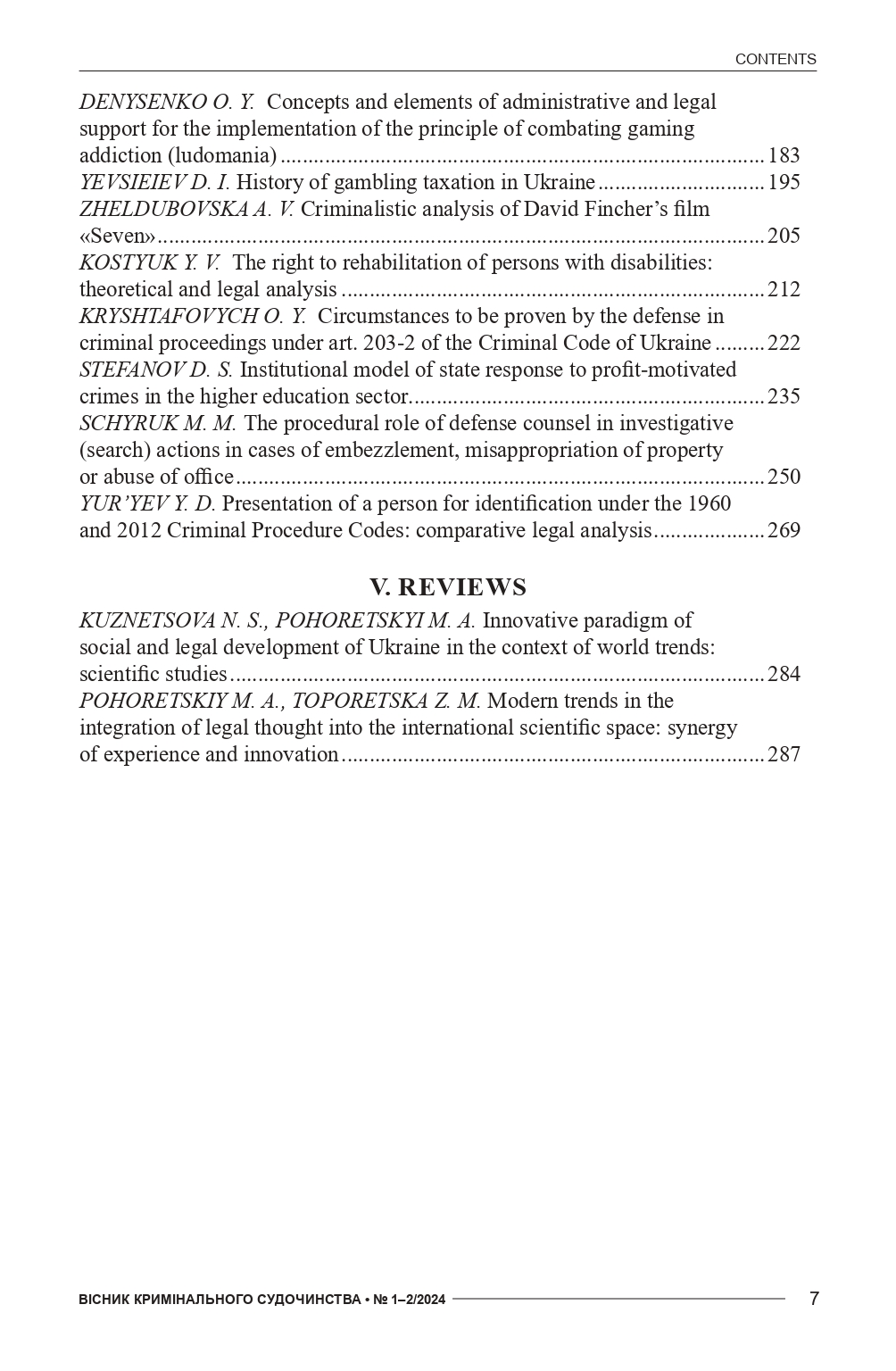
- The procedural role of defense counsel in investigative (search) actions in cases of embezzlement, misappropriation of property or abuse of office
The procedural role of defense counsel in investigative (search) actions in cases of embezzlement, misappropriation of property or abuse of office
Review
The article summarises the regulatory novelties introduced by the 2012 Criminal Procedure Code of Ukraine, the Order of the Prosecutor General’s Office No 112 of 15 May 2024 and the Order of the Ministry of Justice No 2111/5 of 2 June 2023, and systematises the latest case-law of the Supreme Court and the High Anti-Corruption Court on the admissibility of evidence obtained during searches and covert investigative (detective) actions in proceedings under Article 191 of the Criminal Code of Ukraine. An analysis of 42 Supreme Court (Criminal Cassation Court) rulings from 2023–2024 shows that the main grounds for excluding evidence are investigators’ excess of the search warrant’s scope, the absence of uninterrupted video-recording, and failure to declassify authorisations for covert actions.
The study focuses on the defence counsel’s tactics: (1) continuous personal video-recording of a search and the immediate entry of objections into the record; (2) challenging the notice of suspicion on the grounds of unsubstantiated loss calculations and procedural flaws; (3) initiating repeat financial-and-economic examinations in accredited private institutions, which often reduces the loss amount below the qualifying threshold.
A step-by-step algorithm is proposed: demanding disclosure of the covert-action authorisation, conducting a technical audit of media with a phonoscopic expert, filing a complaint under Article 303 of the CPC, and, where necessary, submitting a motion for a repeat examination with the alternative expert’s consent and proof of accreditation attached. The methodology combines formal-dogmatic, systems-structural and comparative-legal analysis, supplemented by semi-structured interviews with practising experts and defence lawyers.
The practical value of the research lies in developing an integrated model of defence actions capable of minimising procedural abuses and ensuring genuine adversarial proceedings in cases of embezzlement or misappropriation of property. Scientific novelty is demonstrated by the proposed classification of typical breaches during covert actions and searches and by establishing a direct correlation between the quality of recording such breaches and the frequency with which the cassation court deems evidence inadmissible. Prospects for further research include quantitatively measuring the share of private expert opinions in court practice and implementing artificial-intelligence algorithms for the rapid analysis of large volumes of audio- and video-data, as already discussed in international white-collar-litigation reviews.
Keywords: defence counsel; search; covert investigative actions; admissibility of evidence; video recording; repeat expert examination; Article 191 of the Criminal Code; right to defence; procedural breaches.