ISSN 2413-5372, Certificate of state re-registration of КВ №25381-15321 ПР dated 01.07.2023.

Search

SCIENTIFIC - PRACTICAL JOURNAL "HERALD OF CRIMINAL JUSTICE"

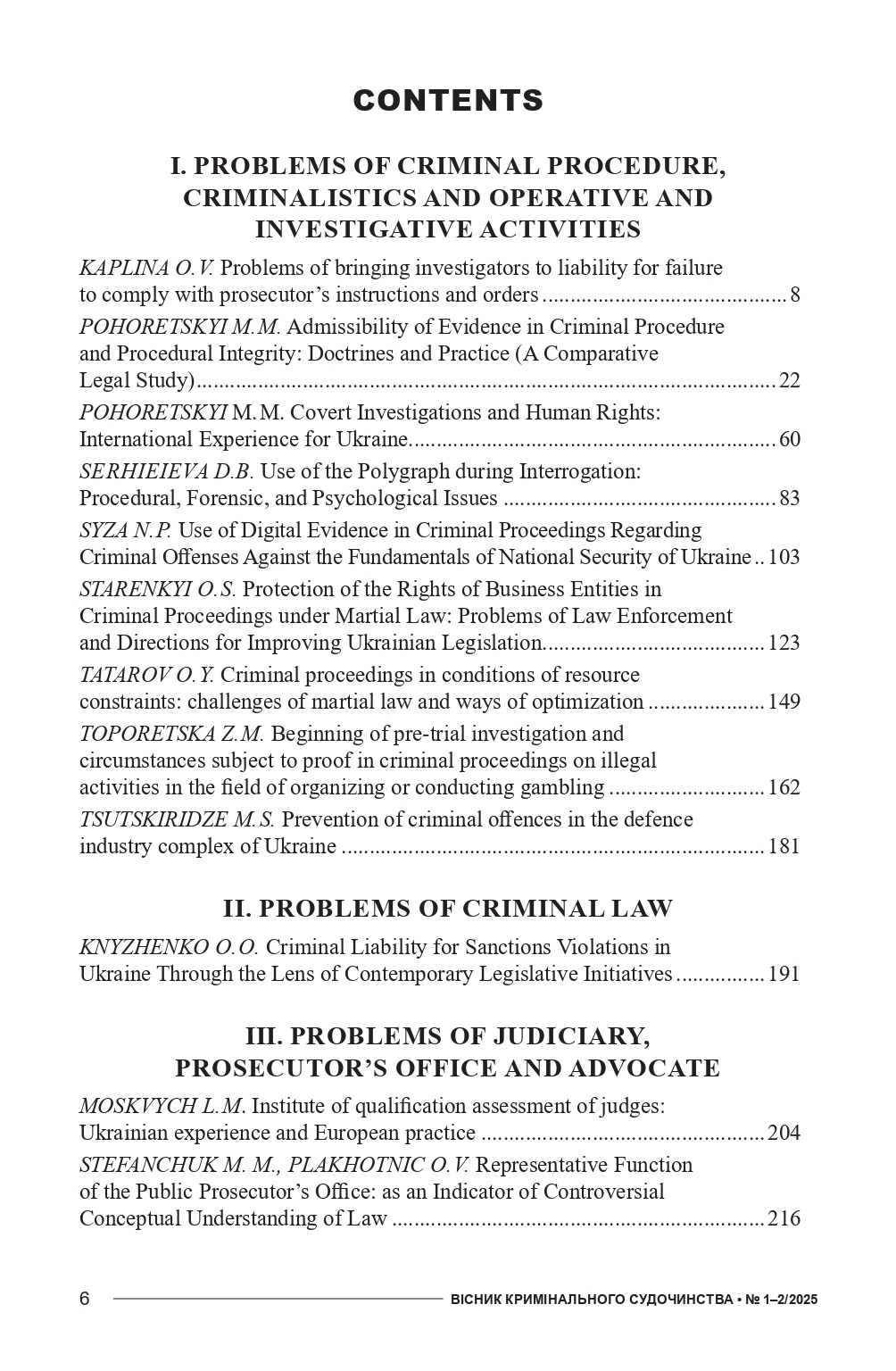
Use of the Polygraph during Interrogation: Procedural, Forensic, and Psychological Issues

Use of the Polygraph during Interrogation: Procedural, Forensic, and Psychological Issues

Pages: 83-102
Year: 2025
Location: Pravova Ednist Ltd

Review

The article provides a comprehensive analysis of the use of the polygraph in criminal proceedings, primarily within the structure of interrogation tactics involving witnesses, victims, and suspects. It examines international standards and foreign case law (Frye, Daubert, Scheffer, Béland, and European court positions), which demonstrate that the polygraph is not admissible as independent evidence due to insufficient scientific validity. Nevertheless, it may serve as an auxiliary orientational tool at the pre-trial stage. Particular attention is paid to the approach of the European Court of Human Rights, which emphasises the necessity of voluntariness, the prohibition of coercion, and the preservation of the individual’s autonomous will.

The article outlines the psychophysiological and psychological foundations of polygraph functioning. The polygraph does not record «truth» or «deception» but physiological responses reflecting emotional tension influenced by fear, anxiety, PTSD, cultural factors, or medical conditions. The risks of false positives and false negatives are highlighted, along with the importance of psychological screening, especially in relation to traumatised victims.

A forensic model for integrating the polygraph into interrogation tactics is substantiated using the «pre-test – test – post-test» structure, which ensures methodological and procedural safety. The article identifies fundamental differences in the use of the polygraph depending on the procedural status of the person: for witnesses – to identify sensitive areas and avoid suggestion; for victims – only in exceptional, psychologically controlled situations; for suspects – exclusively under conditions of full voluntariness, with guaranteed access to defence counsel and strict adherence to the nemo tenetur principle.

Judicial approaches to evaluating polygraph materials are analysed. Such materials may be taken into account only together with other evidence and strictly as orientational data. A specialist’s report must rely on the formula «presence / absence of significant reactions,» with clearly defined in-terpretive limits. The article proposes directions for improving legislation and organisational-methodical practices, including defining the legal status of the polygraph, standardising methodologies, and developing departmental instructions. Future research perspectives include the creation of special protocols for interviewing traumatised victims, empirical assessment of the polygraph’s effectiveness as a tactical tool, and exploring its integration into digital evidence frameworks and the work of justice system institutions during wartime.
References

  1. Bundesgerichtshof (BGH). (1998). Judgment of 17 December 1998–1 StR 156/98 (BGHSt 45, 164). URL: https://dejure.org/dienste/vernetzung/rechtsprechung? Gericht=BGH&Datum=17.12.1998&Aktenzeichen=1+ StR+156 %2F98.
  2. Convention against Torture and Other Cruel, Inhuman or Degrading Treatment or Punishment. (1984). URL: https://zakon.rada.gov.ua/laws/show/995_085.
  3. Convention for the Protection of Human Rights and Fundamental Freedoms. (1950). URL: https://zakon. rada.gov.ua/laws/show/995_004.
  4. Constitution of Ukraine. (1996). URL: https://zakon.rada.gov.ua/laws/show/254к/96-вр.
  5. Criminal Procedure Code of Ukraine. (2012). URL: https://zakon.rada.gov.ua/laws/show/4651–17.
  6. Daubert v. Merrell Dow Pharmaceuticals, Inc. (1993). 509 U.S. 579. URL: https://tile.loc.gov/storage-services/service/ll/usrep/usrep509/usrep509579/usrep509579.pdf.
  7. Desroches, F. J., & Thomas, A. S. (1985). Police Use of the Polygraph in Criminal Investigations. Canadian Journal of Criminology, 27(1), 43–66. URL: https://www.ojp.gov/ncjrs/virtual-library/abstracts/police-use-polygraph-criminal-investigations.
  8. European Court of Human Rights. (2006). Jalloh v. Germany, no. 54810/00, Grand Chamber Judgment of 11 July 2006. URL: https://hudoc.echr.coe.int/eng?i=001–76300.
  9. European Court of Human Rights. (2013). Fazliyski v. Bulgaria, no. 40908/05, Judgment of 16 April 2013.
  10. URL: https://hudoc.echr.coe.int/eng?i=001–118573.
  11. European Court of Human Rights. (2021). Tyagunova v. Russia, no. 41628/11, Judgment of 22 September 2021. URL: https://hudoc.echr.coe.int/app/conversion/pdf/?library=ECHR&id=001–112534.
  12. Federal Rules of Evidence. (n. d.). Rule 403 – Excluding Relevant Evidence for Prejudice, Confusion, Waste of Time, or Other Reasons. URL: https://www.law.cornell.edu/rules/fre/rule_403.
  13. Federal Rules of Evidence. (n. d.). Rule 702 – Testimony by Expert Witnesses. URL: https://www.law. cornell.edu/rules/fre/rule_702.
  14. Frye v. United States. (1923). 293 F. 1013 (D. C. Cir.). URL: https://law.justia.com/cases/district-of-columbia/court-of-appeals/1923/no-3968.html.
  15. Gannon, T. A., & Ward, T. (2014). Polygraph Testing, Credibility and Criminal Justice: A Critical Analysis.
  16. Legal and Criminological Psychology, 19(2), 194–209.
  17. Handler, M., & Honts, C. R. (2021). The Polygraph and Credibility Assessment: Theory and Practice. In Handbook of Forensic Psychology (pp. 377–398). Oxford University Press. DOI: 10.1093/ oxfordhb/9780198816433.013.016.
  18. Handler, M., & Shurany, T. (2019). Psychophysiological Detection of Deception: The State of Science and Practice. Journal of Forensic Sciences, 64(1), 132–146. DOI: 10.1111/1556–4029.13885.
  19. Honts, C. R., Thurber, S., & Handler, M. (2021). A Comprehensive Meta-Analysis of the Comparison Question Polygraph Test. Applied Cognitive Psychology, 35(2), 411–427. DOI: https://doi.org/10.1002/ acp.3779.
  20. Iacono, W. G. (2019). Effective Use of the Polygraph in Criminal Investigations. Annual Review of Law and Social Science, 15, 97–120. DOI: 10.1146/annurev-lawsocsci-101518–042735.
  21. Înalta Curte de Casaţie şi Justiţie. (2012). Decision No. 1894/2012 – Use of Polygraph Testing in Criminal Procedure. URL: https://legeaz.net/spete-penal-iccj-2012/decizia-1894–2012.
  22. International Criminal Court. (2012). The Prosecutor v. Thomas Lubanga Dyilo, Case No. ICC-01/04–01/06, Judgment pursuant to Article 74. URL: http://casebook.icrc.org/case-study/icc-prosecutor-v-thomas-lubanga-dyilo.
  23. Kramatorsk City Court of Donetsk Region. (2021). Judgment of 15 June 2021 in case No. 229/3931/17.
  24. URL: https://zakononline.ua/court-decisions/show/98021483.
  25. Mohyliv-Podilskyi City District Court. (2023). Ruling of 22 May 2023 in case No. 138/1462/22. URL:
  26. https://reyestr.court.gov.ua/Review/111046175.
  27. National Research Council. (2003). The Polygraph and Lie Detection. Washington, D.C.: National Academies Press. URL: https://nap.nationalacademies.org/catalog/10420/the-polygraph-and-lie-detection.
  28. Pohoretskyi, M. (2009). The New Criminal Procedure Code of Ukraine: Political, Theoretical and Legal Issues. Pravo Ukrainy, 2, 29–35.
  29. Pohoretskyi, M. (2015). A New Concept of Criminal Procedural Evidence. Herald of Criminal Procedure, 3, 63–79. URL: https://vkslaw.knu.ua/images/verstka/3_2015_Pogoretskyi.pdf.
  30. Pohoretskyi, M. A. (2002). Criminal Procedural Relations: Structure and System. Kharkiv: Arsis LTD, 160 p.
  31. Pohoretskyi, M. A. (2009). Polygraph: Genesis and Prospects of Admissibility in Criminal Procedure and Operational-Search Activity. In Special Equipment in Law Enforcement Activities (IV International Conference, Kyiv), 97–103.
  32. Pohoretskyi, M. A. (2010). The Polygraph in Operational-Search Activity: Genesis and Prospects of Use.
  33. In International Police Encyclopedia, Vol. VI, 725–726. Kyiv: Atika.
  34. Pohoretskyi, M. A. (2011). Evidence in Criminal Procedure: Problematic Issues. Ostroh Academy Law Review, 1(3). URL: https://lj.oa.edu.ua/articles/2011/n1/11pmappp.pdf.
  35. Pohoretskyi, M. A. (2013). Evidence in Criminal Procedure: Concepts, Content, Structure. In Proceedings of the National Internet Conference on Criminal Procedure (Odesa), 17–21.
  36. Pohoretskyi, M. A. (2014). The Defense Counsel as a Subject of Evidence at the Pre-trial Stage. In Topical Issues of State Formation in Ukraine (Kyiv), 480–482.
  37. Pohoretskyi, M. A. (2023). The Use of Novel Technologies in the Investigation and Proof of War Crimes. Herald of Criminal Procedure, 3–4, 84–102. DOI: 10.17721/2413–5372.2023.3–4/84–102. URL: https://vkslaw. com.ua/index.php/journal/article/view/485.
  38. Pohoretskyi, M. A., & Hryniuk, V. O. (2018). Notification of a Judge of Suspicion: Legal Regulation Issues.
  39. Herald of Criminal Procedure, 1, 58–71. URL: https://vkslaw.com.ua/index.php/journal/article/view/272.
  40. Pohoretskyi, M. A., & Sergieieva, D. B. (2012). Criminalistic Tactics: On the Definition of the Concept.
  41. Ostroh Academy Law Review, 1(5). URL: https://lj.oa.edu.ua/articles/2012/n1/12pmasvp.pdf.
  42. Pohoretskyi, M. A., & Sergeieva, D. B. (2016). Defence Counsel’s Tactics: Concept, Content and Place within the System of Criminalistic Tactics. Visnyk Kryminalnoho Sudochynstva, (2), 113–123. URL: https://vkslaw.knu.ua/images/verstka/2_2016_Sergeeva.pdf
  43. Pohoretskyi, M. A., & Sergieieva, D. B. (2017). Problematic Issues of the Victim’s Procedural Status. Uzhhorod National University Law Review, 46(2), 118–123. URL: https://dspace2.uzhnu.edu.ua/ items/08598282-ac04–4671-b955-b7e94ef07673.
  44. Pohoretskyi, M. A., & Shchyruk, M. (2025). Participation of Defense Counsel in Proving Cases of Embezzlement or Misappropriation. Knowledge, Education, Law, Management, 3, 139–150. DOI: 10.51647/ kelm.2025.3.20. URL: https://kelmczasopisma.com/ua/jornal/98.
  45. Rome Statute of the International Criminal Court. (1998). URL: https://zakon.rada.gov.ua/laws/show/995_588.
  46. Sąd Najwyższy. (2014). Resolution of 29 October 2014, I KZP 25/14 – Use of Polygraph Examinations in Criminal Procedure. URL: https://www.sn.pl/sites/orzecznictwo/Orzeczenia3/I%20KZP%2025–14.pdf.
  47. Shumylo, M. Ye., & Pohoretskyi, M. A. (2012). Evidence and Proof. In Criminal Procedure Code of Ukraine: Scientific and Practical Commentary, Vol. 1 (pp. 247–308). Kharkiv: Pravo.
  48. Starenkyi, O. S. (2016). Criminal Procedural Guarantees of the Defence Counsel as a Subject of Proof in Criminal Proceedings (monograph). Kyiv: Alerta. 336 p.
  49. Supreme Court of Ukraine. (2023). Judgment of 26 January 2023 in case No. 183/3452/19. URL:
  50. https://reyestr.court.gov.ua/Review/108686155.
  51. United States v. Scheffer. (1998). 523 U.S. 303. URL: https://supreme.justia.com/cases/federal/us/523/303/. Vrij, A., & Fisher, R. P. (2020). Detecting Deception in Forensic Contexts: A Review of Psychological Research and Practical Recommendations. Applied Cognitive Psychology, 34(3), 449–460. DOI: https://doi.
  52. org/10.1002/acp.3610.
  53. Vrij, A., Granhag, P. A., Mann, S., & Leal, S. (2017). Outsmarting the Lie Detector: Psychological Perspectives on Polygraph Testing. Current Directions in Psychological Science, 26(2), 123–128.


Keywords: polygraph; interrogation; criminal procedure; evidence; forensic support of investigation; forensic tactics; psychophysiological testing; witness; victim; suspect; nemo tenetur; psychological trauma; ECtHR; voluntariness; procedural safeguards; analytical tool; war crimes; digital evidence.
Affiliations: Doctor of Juridical Sciences, Professor, Honoured Lawyer of Ukraine; Chief Research Fellow at the National Academy of the Security Service of Ukraine; polygraph examiner, clinical psychologist Kyiv, Ukraine
ORCID: https://orcid.org/0000-0003-1005-7046

Use of the Polygraph during Interrogation: Procedural, Forensic, and Psychological Issues

Шановні колеги!

Редакція наукового фахового журналу «Вісник Кримінального судочинства» повідомляє про початок роботи оновленої версії веб-сайту нашого видання – vkslaw.com.ua.

Запрошуємо авторів ознайомитися з оновленими вимогами до оформлення статей та подання матеріалів для публікації за посиланням- Інструкції для авторів

Щиро вдячні за вашу наукову активність та співпрацю!

З повагою,
Редакційна колегія журналу
«Вісник Кримінального судочинства»