- Journal Issues
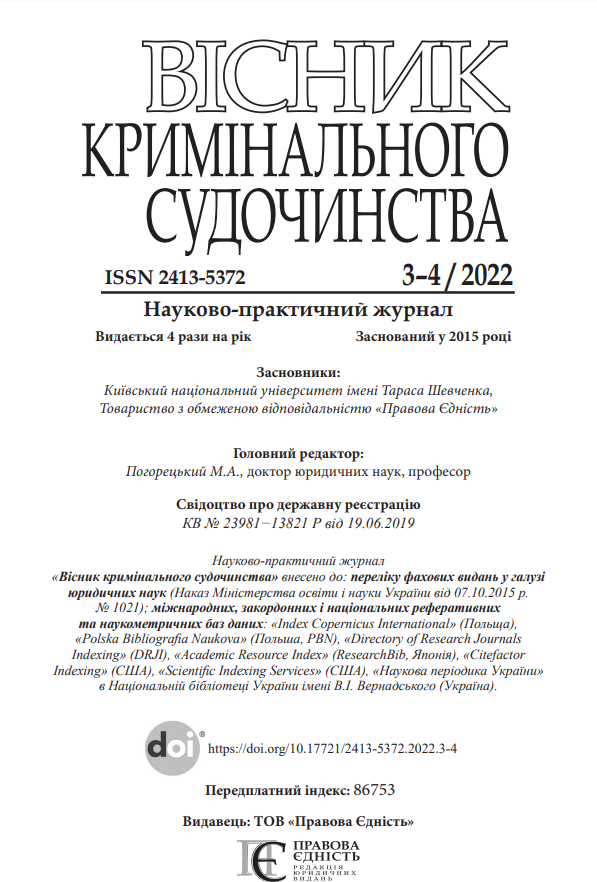
- № 3-4, (2022) Actual problems of criminal justice
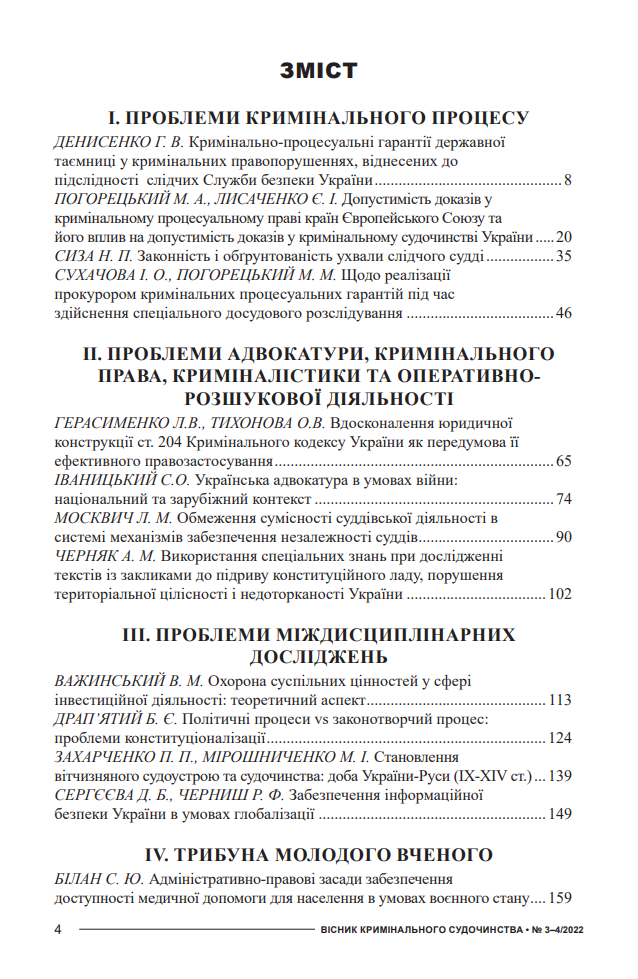
- Problems of the Bar, Criminal Law, Criminology and Operational-Search Activity
- Adversariality as a guarantee of the administration of justice in criminal proceedings

Adversariality as a guarantee of the administration of justice in criminal proceedings
Review
The findings include: (1) demonstrating the link between adversariality and the judicial function across three interconnected dimensions—institutional (the role of the court/investigating judge as a neutral process organizer), procedural (rules on disclosure, symmetry of time and means, order of evidentiary examination, prohibition of \"surprise evidence\"), and evidentiary (access to sources, feasibility of cross-examination, limits on the use of derivative statements and testimony with restricted disclosure); (2) formulating practical criteria of adversariality’s \"guarantee capacity\" at the pre-trial stage: genuine access to materials, timely judicial response to resource asymmetry, and effective compensatory mechanisms where disclosure is lawfully restricted; (3) specifying the judicial role in preventing tactical abuses through process management (\"case management\"), a disclosure calendar, a matrix of contested evidence, and reasoning standards; (4) defining the evidentiary \"weight\" limits of materials from CISA and OSA through requirements of lawful grounds, proper documentation of acquisition, preservation of original media, feasibility of independent technical verification, and provision to the defence of sufficient \"gist\" for meaningful challenge.
The article’s originality lies in a proposed system of criteria for assessing adversariality as a guarantee of justice that integrates institutional, procedural, evidentiary, and compensatory elements and is suitable for practical application in decisions of investigating judges and first-instance courts. Its practical value consists in offering algorithms for participants in proceedings: for courts – a standardized approach to checking \"equality of arms\", organizing the order of evidentiary examination, and selecting procedural sanctions; for the prosecution – discipline of disclosure and a proper \"duty to preserve evidence\" with due regard to the \"chain of custody\"; for the defence – clear guidance on motions for access, continuances, exclusion of inadmissible information, and the use of cross-examination tools.
The legis ferenda section proposes codifying a minimum disclosure standard (deadlines, scope, sanctions), regulating access to digital copies and access logs, entrenching a preliminary hearing, and unifying reasoning templates on equality of arms. The study concludes that only the synchronized operation of neutral yet effective process management, predictable disclosure rules, and correct application of the beyond-reasonable-doubt standard converts adversariality from a declaration into a working guarantee of a fair verdict at all stages of criminal proceedings.
Keywords: adversariality; equality of arms; adversarial proceedings; disclosure; preliminary hearing; judicial control; cross-examination; beyond reasonable doubt; covert investigative (search) actions; operational-search activity; surprise evidence; procedural sanctions; reasoning of judicial decisions; duty to preserve evidence; chain of custody.