- Journal Issues
- № 3-4, (2024) Actual problems of criminal justice
- Young scientist tribune
- Operational and investigative documentation of crimes in higher education institutions of the Ministry of Education and Science: problematic issues of evidence, legalization and prevention of provocation
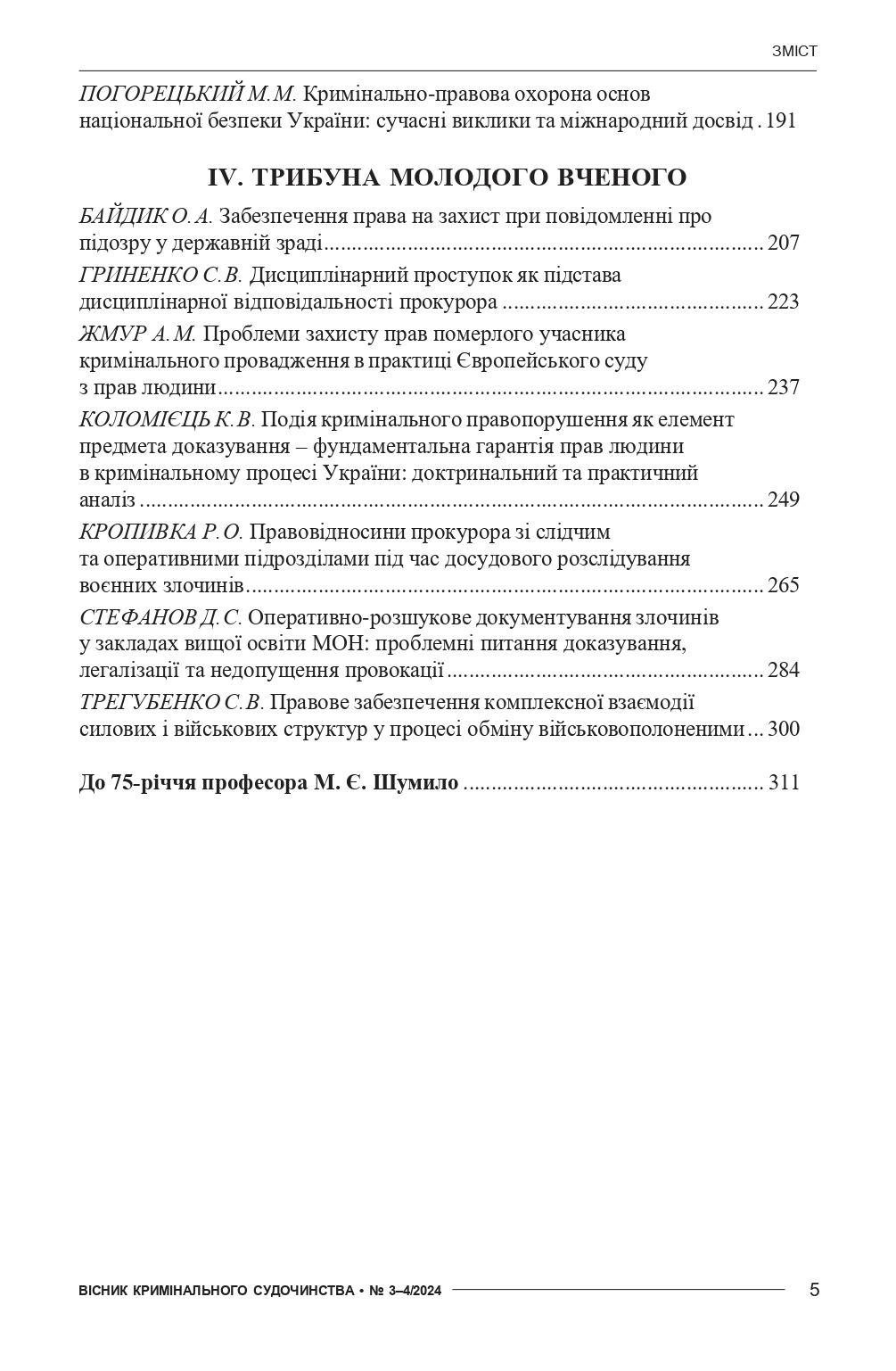
Operational and investigative documentation of crimes in higher education institutions of the Ministry of Education and Science: problematic issues of evidence, legalization and prevention of provocation
Review
The article is devoted to a comprehensive study of the theoretical, regulatory, and practical foundations of operational and investigative documentation of crimes in higher education institutions under the system of the Ministry of Education and Science of Ukraine. The relevance of the topic is substantiated in the context of contemporary challenges related to the spread of corruption, abuse of power, bribery, falsification of academic results, violations of academic integrity, and misuse of public funds. The social significance of documenting crimes in higher education is defined as one of the key elements of the state anti-corruption policy aimed at ensuring legality, transparency, and integrity within the educational process.
The purpose of the article is a comprehensive study of the legal and practical foundations of operational and investigative documentation of crimes in higher education institutions, particularly issues of evidence, legalization of operational materials, and prevention of crime provocation.
The article reveals the legal nature of operational and investigative documentation as a system of actions aimed at identifying, recording, and reflecting the circumstances of a crime using legally established methods and means. The functional role of documentation within the structure of operational and investigative activity is analyzed, as well as its importance in forming the evidentiary base and ensuring the effective investigation of criminal offenses in universities. It is established that operational documentation performs not only an evidentiary but also a preventive function, helping to prevent new criminal acts, while requiring strict adherence to the principles of legality, proportionality, ethics, and minimal interference in university autonomy.
Based on an analysis of the Constitution of Ukraine, the Criminal Procedure Code of Ukraine, the Laws of Ukraine «On Operational and Investigative Activities,» «On Higher Education,» «On Prevention of Corruption,» and departmental regulations of the Ministry of Internal Affairs, the Security Service of Ukraine, and the National Agency on Corruption Prevention, the study identifies the legal limits of admissibility for operational measures in educational institutions. Special attention is paid to the issue of legalization of operational materials, their transformation into procedurally admissible evidence, and the identification of common procedural violations that lead to the inadmissibility of such evidence in court. The article thoroughly examines the problem of crime provocation as the limit of admissibility of operational experiments, in the light of the European Court of Human Rights decisions (Ramanauskas v. Lithuania, Teixeira de Castro v. Portugal), emphasizing the risks of provocative methods in higher education institutions that undermine public trust and violate academic freedoms.
The study also explores the ethical, legal, and evidentiary aspects of the work of operational units in universities, emphasizing the importance of moral and psychological training of personnel, adherence to standards of integrity, and respect for human rights. The article highlights positive examples of cooperation between operational services, anti-corruption officers of universities, and the National Agency on Corruption Prevention (2024). It proposes improving interagency instructions of the MIA and the SSU, introducing a separate article into the Criminal Procedure Code of Ukraine to regulate the legalization of operational materials, developing unified standards of interaction between law enforcement and educational institutions, and establishing a system of ethical and legal training for operational officers to prevent crime provocation.
The research results have both theoretical and practical significance for the development of evidentiary law, improvement of law enforcement activities, and ensuring the protection of constitutional rights and freedoms of participants in the educational process during operational and investigative actions.
Keywords: operational and investigative documentation, higher education institutions, evidence, admissibility, legalization of operational materials, crime provocation, operational experiment, anti-corruption activity, procedural guarantees, academic integrity, human rights.