- Journal Issues
- № 3-4, (2024) Actual problems of criminal justice
- Young scientist tribune
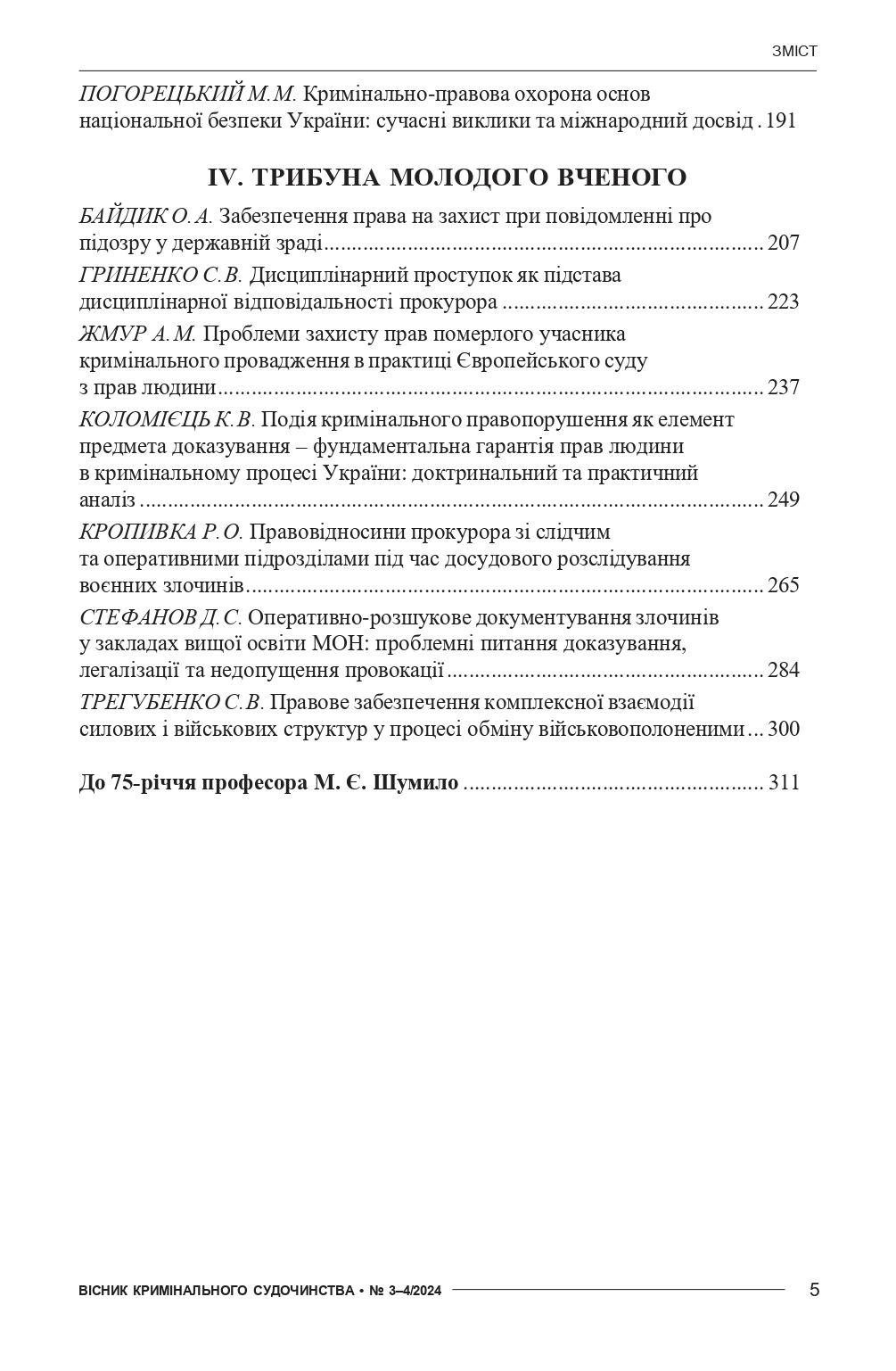
- Legal Relations Between the Prosecutor, Investigator, and Operational Units During the Pre-Trial Investigation of War Crimes
Legal Relations Between the Prosecutor, Investigator, and Operational Units During the Pre-Trial Investigation of War Crimes
Review
The article presents a comprehensive study of the legal relations between the prosecutor, the investigator, and operational units during the pre-trial investigation of war crimes under the conditions of martial law. It reveals their legal nature, content, structure, and functional purpose within the system of criminal procedure. It is substantiated that these legal relations form an integral system of authority-procedural connections combining the prosecutor’s managerial, coordination, and supervisory functions with the investigator’s professional autonomy and the operational independence of specialized units. Theoretical and practical foundations of prosecutorial supervision in war crimes proceedings are determined, the distinction between prosecutorial supervision and departmental control is outlined, and the vertical and horizontal interconnections between the subjects of proof are characterized.
The study analyzes current Ukrainian legislation, international standards for investigating war crimes, and the practice of their implementation in the interaction among the prosecutor’s office, pre-trial investigation bodies, and operational structures. It demonstrates that the effectiveness of documenting and proving war crimes largely depends on proper coordination of actions, the unity of evidence policy, and ensuring the legality of using results of operational-search and covert investigative (search) actions. The paper highlights problems of law enforcement associated with the uncertainty of the limits of prosecutorial supervision, conflicts between national norms and international standards of admissibility of evidence, as well as the absence of unified procedures for interagency cooperation.
The article proposes directions for improving Ukraine’s criminal procedural legislation, which include clear normative delineation of powers among the prosecutor, investigator, and operational units, the introduction of special procedures for verifying digital evidence, reproducing its authenticity, and confirming the continuity of the chain of custody. It also substantiates the necessity of establishing a national digital evidence management system in accordance with international standards of the European Network of Forensic Science Institutes (ENFSI) and the Berkeley Protocol on Digital Open Source Investigations.
Keywords: prosecutor; investigator; operational units; war crimes; pre-trial investigation; prosecutorial supervision; coordination of evidence; operational-search activity; admissibility of evidence; digital evidence; international standards; ENFSI; Berkeley Protocol.