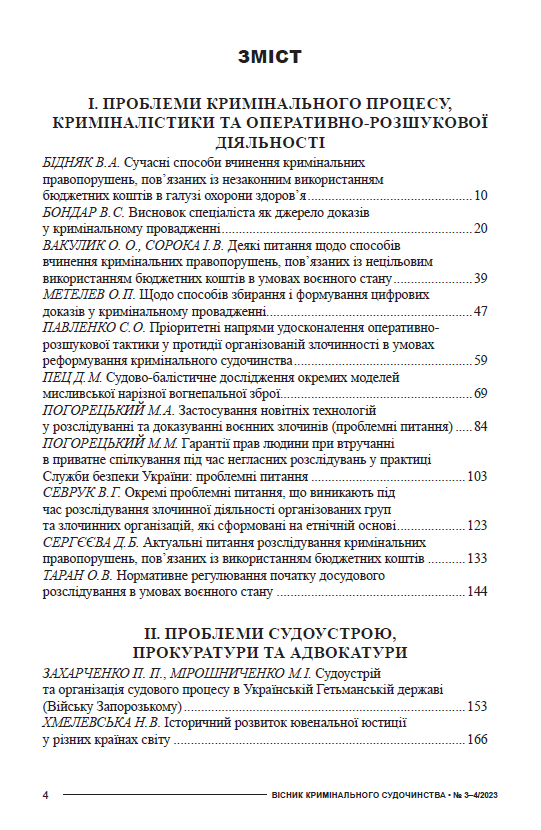
APPLICATION OF ADVANCED TECHNOLOGIES IN THE INVESTIGATION AND PROOF OF WAR CRIMES (PROBLEMATIC ISSUES)
Pages: 84-102
Year: 2023
Location: Pravova Ednist Ltd
Дата публікації: 28.01.2024
Keywords
war crimes, space technologies, geoinformation systems, satellite imagery, artificial intelligence, blockchain, biometric technologies, OSINT, international law, human rights, evidence, proof, documentation, investigation, judicial control, prosecutorial supervision.
Review
The article is devoted to analyzing the role and potential of advanced technologies in documenting, investigating, and proving war crimes amid Russian aggression against Ukraine. There is an analysis of the role of advanced technologies in documenting, investigating, and proving war crimes, as well as a justification for the necessity of further implementing the most effective among them into the theory of operational-investigative activities, criminalistics, and criminal procedure, as well as into the practice of law enforcement agencies. The author thoroughly analyzes the capabilities and practical aspects of using space and geoinformation technologies, particularly satellite imagery, which enable obtaining precise, timely, and indisputable evidence of war crimes. Examples of successful application of these technologies include cases of mass graves in Bucha and Izium, as well as large-scale destruction of civilian infrastructure in Mariupol and Kharkiv. The study emphasizes the exceptional effectiveness of space and geoinformation technologies (especially satellite images) in providing reliable crime evidence, virtually eliminating falsification through digital electronic signatures. It is argued that digital and biometric technologies, such as artificial intelligence, blockchain, facial recognition, and DNA analysis, are also essential. The use of these technologies in Ukraine has facilitated rapid identification of both victims and potential perpetrators. Blockchain-based systems create secure and transparent chains of evidence crucial for subsequent international judicial proceedings. The study demonstrates that machine learning algorithms effectively analyze large volumes of digital data, significantly reducing investigation time and ensuring a high level of evidential quality. Such technologies are actively used in OSINT investigations and interagency databases, substantially improving law enforcement coordination. The article highlights that employing advanced technologies raises numerous legal, ethical, and technical challenges, such as personal data protection, prevention of misuse, and compliance with human rights standards. This necessitates establishing relevant legal and ethical frameworks at both national and international levels. The conclusion emphasizes that active implementation and regulatory support for advanced technologies are crucial for enhancing the effectiveness of documentation, investigation, and proof of war crimes, thus ensuring justice in national and international criminal justice systems. Integrating advanced technologies into the documentation and investigation processes of war crimes is critically important for achieving justice for victims and effectively holding perpetrators accountable. Further research and regulatory oversight of this process are necessary to comply with international standards and protect human rights.